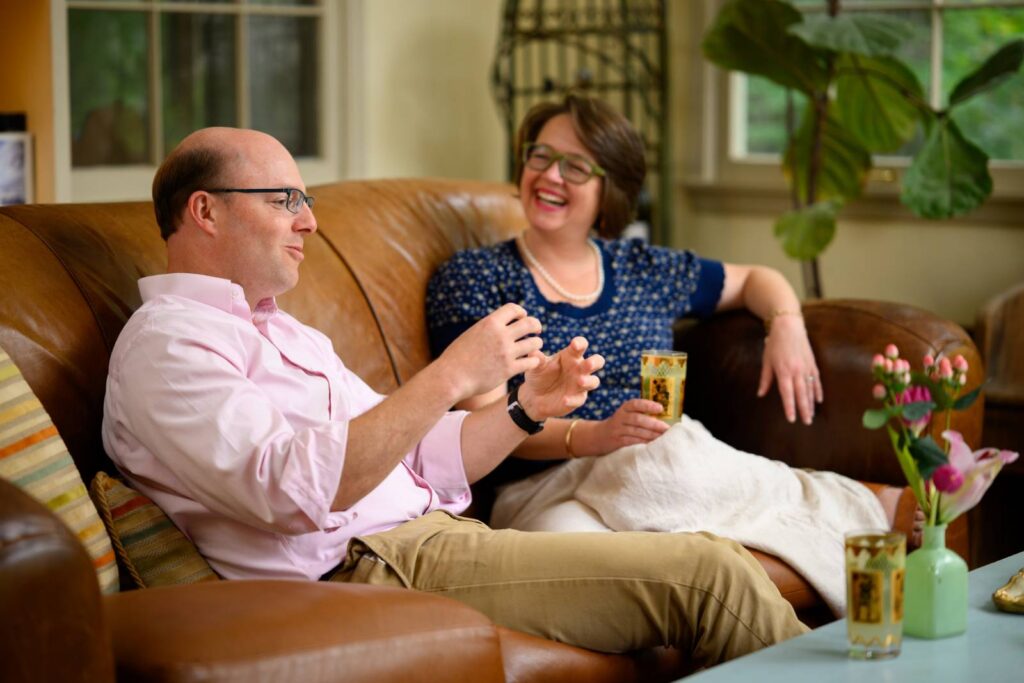
Tucked around the corner from the tail end of a major thoroughfare, the Forster home sits on a quiet street in northeast Jackson. But on the inside, the house is rarely quiet. Two adults, four kids (when they’re all here), a dog, and a cat call this place home, along with innumerable books, paintings, photographs, and other items that nearly exude as much life as the human inhabitants.

Right now, there are only four humans: Paul and Ann Lowrey Forster, plus two guests, a writer and a photographer. And we are guests. The coffee table boasts a Florentine tray with a pitcher of limeade and glasses. On the table behind us sits a plate of brownies. Before we leave today, Joe and I will have consumed a satisfying amount of both.
“Are we doing the sit-down in here?” Ann Lowrey asks. She wants to know which areas to declutter while Joe sets up the lighting. She and Paul whisk around the living room and family room. Flowers are relocated and rearranged. Dishes are hidden in the sink.
But nothing is perfected. Early in the interview, we hear a soft, plastic crash behind the sofa. A game of Monopoly has tumbled off its perch.
The Forster home, in the best way, remains as busy as ever.
Pack ’n plays and tough turkeys

Paul and Ann Lowrey try not to let a week go by without having people over. Friends and family, colleagues, fellow church members, parents of their kids’ friends … That usually doesn’t mean a fancy dinner party with hand-painted place cards (though that does happen), but food and genuine fellowship.
“I grew up in a Mississippi that still touted hospitality but really kind of thought it meant entertaining,” Ann Lowrey says. “I wasn’t hearing people talk about hospitality as a way to minister to people and create community.”
As newlyweds, she and Paul practiced hospitality out of necessity.
“We met at Ole Miss, married young, had a bunch of babies very young,” she says. “We bought a little bitty house in Fondren, very beat-up. We were too poor to go out, (and we had) babies that needed to go to bed at 7 p.m. That’s how we got to be people who had people over.”
They invited their friends and their friends’ kids. “We put pack ’n plays in the back of the house. I think at some point we had 16 children (at the house), with six couples trying to have dinner.”
The Forsters also volunteered early on to host the family Thanksgiving – which didn’t always go to plan.
“There is a turkey in ‘Come On In,’ the Junior League cookbook. It’s an overnight turkey. You bring it up to a certain temperature in the oven, and you tent it with foil really tightly and then turn it off and let it slow roast overnight. I had done it the year before, and it was great.
“(This time, on Thanksgiving morning,) I cut into the turkey, and do you remember ‘Christmas Vacation,’ where the turkey goes, ‘Sssss’ (and is basically inedible)? … it was a very similar experience.” She had to run over to McDade’s, buy another turkey, and start over.
Today, Thanksgiving dinners are less likely to involve throwing out a whole bird. Years of practice have borne fruit for Ann Lowrey, who considers cooking both her therapy and her art.
However, “last night, I had plastic plates, ordered food from a restaurant, and left it in its foil containers (to host my coworkers).”
For the Forsters, it’s not about what you prepare, how you present it, or even whether it’s homemade. Instead, it’s about community.
“We think as modern people we don’t need that stuff anymore,” Paul says. “It’s not until either you’ve been doing it for so long that you realize, hey, this is really important, or you haven’t been doing it and realize how much you miss it.
“Literally just the act of eating together is structurally how we’re built. That’s why it’s such a central metaphor (in scripture).”
From the Last Supper that became one of the church’s primary sacraments, to the coming marriage feast of the Lamb in eternity, gathering around the table with other believers is about far more than food.
Balancing beauty and comfort
The Forsters bought their current home after having their fourth child, and they hope they never have to leave. “Nobody’s (in the lot) behind us, so there are some trails through the woods,” Paul says. “We love it here.”
His favorite room is the family room, where we’re sitting. In the mornings, he can relax with his coffee and Bible at a table by the window and enjoy dappled shade from the backyard.
It doesn’t hurt that the furniture, artwork, and home itself are the perfect level of lived-in – from the miniature shelves adorned with family photos along the stairwell, to the scent of ash from the wood-burning fireplace in the living room.
The vignettes of floral arrangements and art are all Ann Lowrey, who says, “My mother taught me to see details and care about beautiful things and flowers.”
Thanks to Paul, that beauty doesn’t become untouchable.
“When we were first married, he tutored a lot and was in a lot of fine homes, and he said, ‘I do not want to live in a museum. I want rugs and lamps and stacks of books,’” she recalls. “And I was like, yes sir! It was sweet to hear a man have a strong opinion about that.”
That same blend of beauty and comfort shows up in the Forsters’ hospitality today. But it’s been a journey.
Ann Lowrey admits she was a stressed-out hostess in the early years: “For the last 30 minutes before people came, I was not kind to my family.” (One time, in a tizzy, she transposed her words: “Somebody wipe the cushions and fluff the counters!” That’s a running joke to this day.)
Meanwhile, Paul stood on the other extreme. “(His) original position was, I see the bad in this (when it’s done for performance). Let’s have our sweatpants on,” Ann Lowrey recalls.
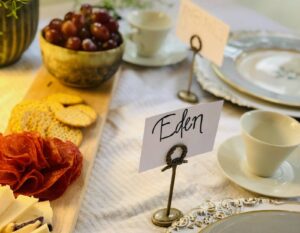
“The compromise position has been me saying, I see the bad too. Let’s root it out (but) embrace the fact that we come from Eden and are headed to heaven, and there’s going to be a feast with good food and beautiful flowers.”
Not everybody enjoys creating ambience like Ann Lowrey, but most folks are completely capable of having people over. Just don’t wait until you’re “not busy,” Paul says.
“If hospitality goes away when life gets busy, then the only time you’re having people over is for a baby shower (or other event). Hospitality and having a welcoming home is different than hosting a party.”
Instead, he says, hospitality looks like calling up a friend and inviting them over: “We have extra red beans and rice. I haven’t seen your face or talked to you in three months.”
When you do that, “to go from normal life to comfortable for guests is only about 10 minutes’ worth of cleaning,” Paul says. Emphasis on “comfortable,” not “pristine.”
Similarly, while Ann Lowrey believes God made people to enjoy beautiful things, she has learned to create those things “from a place of delight … not shame-avoidance or pride,” she says. “Otherwise it eats your soul.”
‘I’m bringing lunch’
In 2013, the Forsters and 12 other couples founded St. Augustine School, a classical Christian school now located on Highland Colony Parkway in Ridgeland. “We observed a world of busyness coming for us,” Ann Lowrey shared on the St. Augustine website, and “(instead sought) a life that allowed for long evenings.”
At St. Augustine, education happens partly at the school itself and partly at home. Another distinctive? You guessed it: Hospitality.
“We took up the mantle of feeding the community there really early,” Ann Lowrey says. “I wanted my teachers and my moms to feel the hospitality of a home, which is different than the hospitality of a school.”
That desire has only grown since Ann Lowrey became head of school in 2023. That gathering of colleagues, the night before this interview? It was the St. A faculty, coming over for a reading of C.S. Lewis’ “The Screwtape Letters.”
“It was part of our professional development,” she says. “We called it Cinco de Screwtape, since it was Cinco de Mayo.”
As a leader, feeding folks is “a very easy way to love the people you work with,” she says. “When I can, when I make a lot of food over the weekend, I’ll say, ‘Hey, I’m bringing lunch’ (on Monday). You see the light in their eyes.”
But she doesn’t do all the hospitality herself. The school boasts several great hostesses, she says, including one “who loves to make a salad. I have now figured that out. (So whenever I have her do that for a get-together), that means she’s excited about it, and that means it’s going to be good.”
COVID and cold corn salad
In 2020, COVID threw a wrench into everybody’s social lives, but the Forsters pressed on with small, back-porch gatherings centered around leftovers and a livestreamed church service. That led to another of Ann Lowrey’s “favorite” hospitality fails:
“My friend Emily was eating cold corn salad that I had in the refrigerator. I watched her out of the corner of my eye take a bite, (and I saw) her face. She’s the kind of person who never would’ve said anything if I hadn’t seen her, but the cold corn salad had gone bad. … now we get to laugh about it.”
Moral of the story? Well, check your leftovers, but also: Don’t take yourself too seriously when having people over. “Somebody at some point is going to find your child’s panties or eat something unpleasant,” she says.
“If they’re coming over to judge me, we’re not going to be close for very long anyway, because that’s weirdly gross.”
In other words, your home and hospitality will never be perfect, and that’s OK. Go full Southern Living if it brings you and others joy – but the type of food and decor are not what build community.
After years of cooking and hosting, Ann Lowrey can whip up anything from a one-pot dinner to a multi-course feast. The kids cook, too. In fact, the Forsters have a spreadsheet containing, no lie, 80 different suppers. Each recipe is ranked by taste – both freshly made and left over – as well as time and cost.
About every other Monday, the family makes bean burritos. Sometimes, Ann Lowrey puts a salmon filet on the grill. Other times, she grabs a box of “very cheap, very good fried chicken” from Kroger, she says.
“A big part of the habit (of hospitality) is learning tricks.”
‘Who are your people?’

Now that the Forster children are older, they’re carrying on the tradition of hospitality. The two oldest are habitual hosts at college, and all four Forster kids spend Thanksgiving week in the kitchen with their mom.
“It’s ridiculous, the menu we dream up,” Ann Lowrey says. She loves knowing that her children can “create something delightful to bless someone.” Last year, the kids did that for her birthday, kicking her out of the house and tackling all the dinner prep themselves.
So, what good does all this hospitality do – besides teaching young people how to throw their mom a great birthday party?
First, the host themselves can grow spiritually, Ann Lowrey says, if you do some “self-examination” of your motives: “Is this for the Lord’s glory first, then the others’ good, then the fun of it?”
Also, “the others’ good” isn’t just the food, she says. “When you feed people, they trust you, and they come back with their hurts. When you think about people whose house you’ve been in, there’s a closeness that’s not there with others.”
That closeness helps everybody, guests and hosts alike.
“The perseverance of the saints requires a lot of support,” she says. “Without Christian community, you will die. Who are your people who encourage you, who keep you? Are you keeping them?”
That could mean an intentional conversation after dinner, a hand-delivered meal after a loved one’s death, or just being present with each other regularly.
Another way the Forsters practice Christian community is by hosting hymn sings every few months in the family room.
“It’s potluck, and we pull the furniture out, and we can get about 60 people in here, singing a capella hymns. Sometimes somebody sits at the piano,” Ann Lowrey says.
It’s perfectly imperfect and brimming with life. People overflow the family room, and usually somebody’s cup runneth over, literally.
“I’ve given up serving anything other than water, because it always gets spilled.”
Hints for hospitality
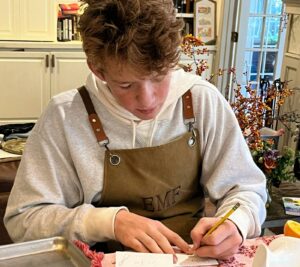
So, just how does one use hospitality to foster genuine, joyful Christian community? Here are some thoughts from the Forsters:
Be the initiator. “(If you’re wondering,) how do I get invited to events (that) are community-based and warm? You start hosting them,” Paul says.
Make it a habit. “If you want this to really be part of your life, you have to make it habitual,” Ann Lowrey says.
Know your limits. “We all feel it, and we don’t like it when it’s too much. We’ve had weeks or months where we feel that tension,” Ann Lowrey says.
Let your guests help. Really! “Most people would like to participate in the work. Work is dignifying. Work was before the fall,” Ann Lowrey says. For instance, if somebody says they love washing dishes and offers to do yours – believe them, and let them!
Don’t feel like you have to go gourmet. “One time after I had had a baby or a surgery or something, a friend of mine who was bringing me dinner said, ‘I did not want to bring you supper, because it’s not going to be good enough,’” Ann Lowrey recalls.
“But I was so excited to eat whatever anybody brought me. That freed me to know that that was true of everybody who came to my house.”
And if you invite people’s children and feed them, too? The parents are ecstatic to leave “with a fed child” and “without dirty dishes,” she says.
Try taking food to others. “Years ago, (my stepmother) started taking us a meal the day we got home from vacation. That’s when you really need a meal.”
For families who could use a home-cooked meal for any reason, Ann Lowrey will prepare it, and Paul will swing by the house after work for pickup and drop-off. Sometimes Ann Lowrey goes with him to eat and visit. Some of the Forsters’ friends have young children now, and “it’s been sweet as of late to be able to say, ‘Can we bring y’all supper after the kids go to bed?’”