By Chris Bates
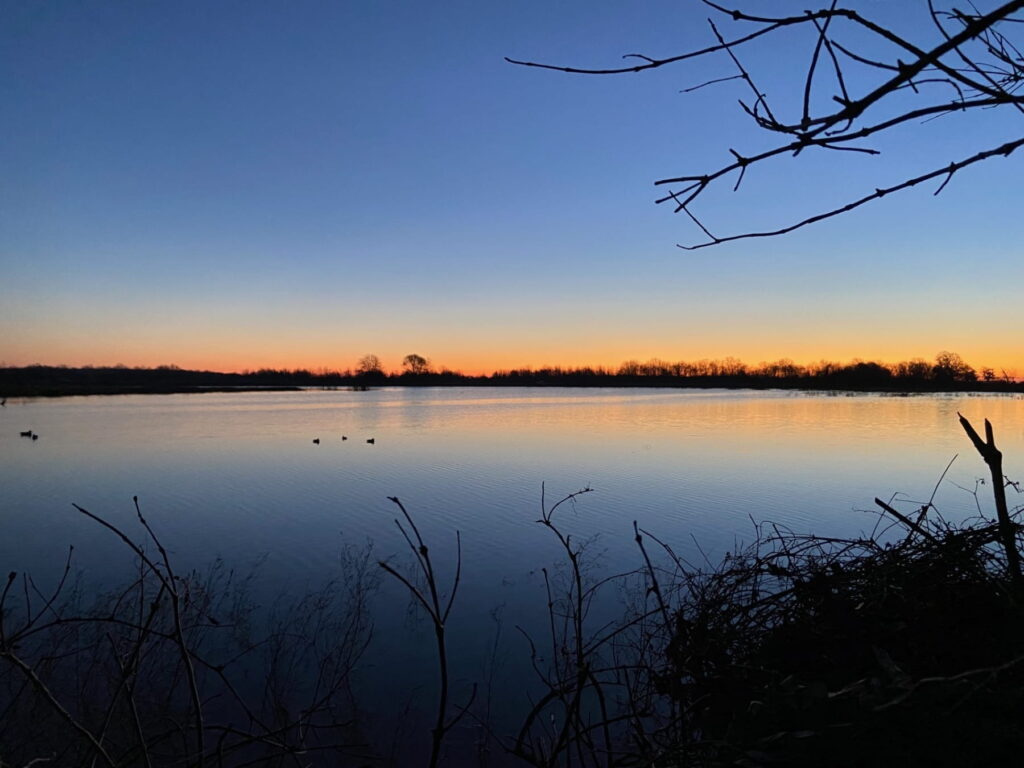
There is a certain kind of quiet in the painted dawn in the Mississippi Delta. The Delta is vast, open, and level, and revealing in its beauty. At first glance, it may seem sparse, but the Delta is rich with hidden life. The woods are alive with critters and birds, and the fields hold more than the eye expects. Its soil is fertile and carries deep memory, shaped ages ago when this place was once covered by water. Because it has smaller rural populations, part of its gift is the space to breathe, to notice, and to be still.

On a recent opening morning of hunting season in the Delta, I arrived well before daylight. Above me, the stars stretched across the sky in ways that cannot be seen under city lights. A light breeze carried the scent of damp earth, and there was a hint of ripened persimmons in the air. Dew dripped from oak leaves overhead. From my perch high in the tree, the first thin line of orange showed on the horizon.
In moments like these, away from noise and routine, the mind slows, and the heart listens. In the stillness, reflection comes more easily.
To reflect on love, it is such a vast subject. We know vertical love is perfect, meaning that God’s love for each of us is limitless and beyond our comprehension. That is likely one reason He gave us His Son, so we could have an inkling of the endless scope of His love. However, horizontal love between us humans is the tough part.
The big storybook tells us in 1 Corinthians 13:4 that “Love is patient, love is kind … ” It goes on to tell us the things that love is and is not. Most of us know those things intellectually. How we practice them while strapped to our brokenness is another matter. Living those things out well is the humanly hard part. We too often qualify or filter them and interject selfishness, fear, hurt, and other fallibilities.
Love is action, given regardless of return. In a marriage, a family relationship, or daily life with friends and coworkers, it can often be expressed by demonstrations, whether we are affirmed for them or not. Those can look like a compliment, a touch, a gift of time, simply listening, or unloading the dishwasher when you don’t feel like it. Human love expressed well is a compilation of countless actions for others through thought, word, and deed.
C.S. Lewis gave another description of giving love regardless of return: “To love at all is to be vulnerable. Love anything and your heart will be wrung and possibly broken. If you want to make sure of keeping it intact, you must give it to no one, not even an animal. Wrap it carefully round with hobbies and little luxuries; avoid all entanglements. Lock it up safe in the casket or coffin of your selfishness. But in that casket, safe, dark, motionless, airless, it will change. It will not be broken; it will become unbreakable, impenetrable, irredeemable. To love is to be vulnerable.”
As we reflect on love, let’s consider not holding back but being vulnerable to giving it as well as receiving it, vertically and horizontally. As we try to model the boundless love given freely to us, taking actions with our neighbors (including the ones we live with) is how we can best gift love and receive it.

Chris Bates is CEO of AgoraEversole, a full-service marketing agency in Jackson, and can be reached at Chris@AgoraEversole.com. He and his wife, Stacy, live in Madison and have adult children and three grandboys.